
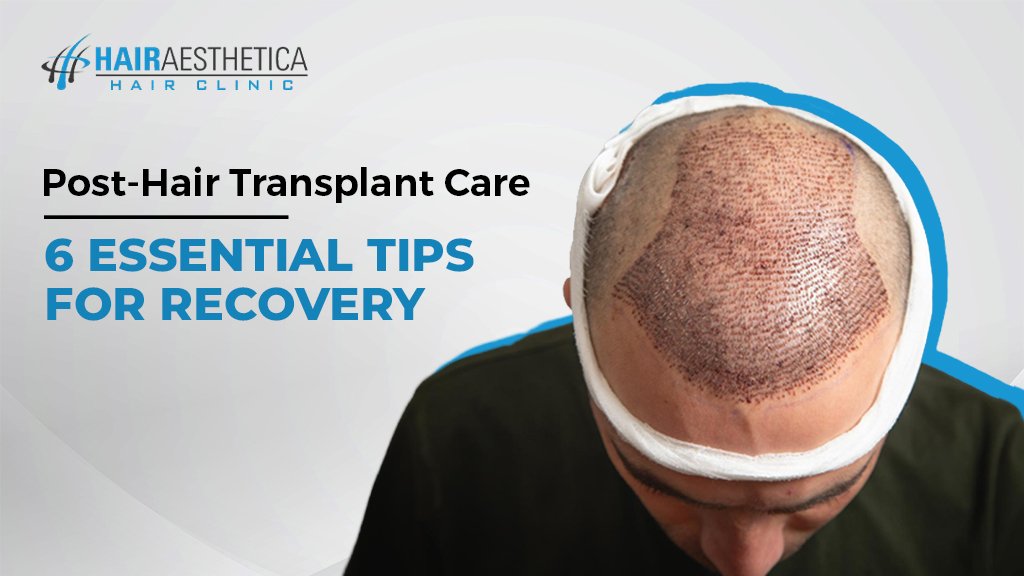
Hair transplant has proved to be one of the most permanent and effective hair restoration solutions. Even though the procedure plays a significant role in achieving natural results, post-hair transplant care also needs to be focused on. It is advisable to follow the recovery guidelines to safeguard newly implanted hair grafts, attain healthy hair growth, and minimize complications.
At Hair Aesthetica, we precisely understand that recovery is an essential phase of the hair restoration journey. Our hair specialist in Prayagraj and the team of surgeons prepare a personalized post-hair transplant plan to accelerate hair regrowth.
Why Post-Hair Transplant Care Should Be Focused On?
Since the hair grafts are still in the settling phase, at a new space, the first few weeks after a hair transplant seem to be critical. If proper care is not focused on, hair graft survival can be affected. The healing can also be delayed.
Did you know?
- With the proper post-hair transplant care, over 90-95% transplanted hair grafts can survive
- The natural-looking results are visible after 10-12 weeks
- The transplanted hair can last for a lifetime and is resistant to future hair loss
- Many patients start noticing hair growth within 3-4 months after the procedure
At this point, let’s take a look at crucial hair transplant recovery tips every patient must follow:
1. Doctor’s instructions should be followed carefully
The aftercare instructions mentioned by your surgeon should be followed. These guidelines may be tailored based on the overall health and transplant method used by the doctor:
- Antibiotics may be prescribed to prevent infection
- Pain management medications may be prescribed
- Anti-inflammatory medicines may be prescribed
- Medicated shampoo or scalp care products may be prescribed
At Hair Aesthetica, we examine the overall health of the patient, and our experienced hair doctor in Prayagraj provides a detailed recovery plan. Our team believes in helping patients attain smooth healing and optimal results.
2. Scratching or touching the scalp should be avoided
Itching or discomfort are often experienced by the patient during the initial phase after the hair transplant procedure. However, it is highly recommended that one should avoid touching or scratching the scalp. Scratching or touching the scalp can affect the survival of hair grafts. Nevertheless, in such circumstances, the following can be considered:
- Prescribed medications should be used to experience soothing relief
- Scalp hygiene should be maintained
- Tight helmets or caps should be avoided during the recovery phase
It is crucial to remember that hair grafts are sensitive and require extra care during the 10-14 days after the hair transplant procedure.
3. Elevated head sleeping pattern
It is advisable to sleep with the head elevated. Inflammation may be noticed around the eyes and forehead after a hair transplant procedure. Therefore, sleeping with an elevated head can reduce swelling and also provide a soothing effect gradually. Ideally, two or three pillows can be used for support while sleeping. You must avoid sleeping on your stomach or side for the first week after the hair transplant procedure.
4. Hair must be washed gently
Infection can be prevented when proper hair-washing habits are followed. This will also remove scabs without affecting the hair grafts. Besides, the first hair wash should be as advised by the doctor. Additionally, the use of lukewarm water and prescribed medicated shampoo is important to attain efficient hair restoration recovery. While washing hair, shampoo should be gently applied to the scalp without rubbing. Hair should be dried gently and not vigorously, as it may hurt and affect the hair follicles.
5. Don’t smoke or use alcohol during the recovery phase
Blood circulation is impacted by smoking and alcohol consumption. This further reduces the supply of oxygen; hence, the flow of nutrients is also restricted to hair follicles. Thus, it is highly recommended by hair specialists to avoid smoking and alcohol during the recovery phase after a hair transplant.
6. Strenuous physical activities should be avoided
Blood pressure and sweating increase through strenuous physical activities such as running, gym workouts, swimming, weightlifting, etc. Therefore, to make the healing process smooth, these activities must be avoided for the initial few weeks.
Planning to get detailed assistance related to hair transplant and recovery plan? Reach out to our hair specialist in Prayagraj and seek personalized inputs. At Hair Aesthetica, we conduct clinical examinations, understand the hair loss history of the patient, and check the eligibility for surgery. Lastly, we also advise non-surgical hair restoration options to patients who are not eligible for hair transplant surgery. The hair transplant recovery options are also planned according to the recommended procedure.
